Free Saturation VST – Drive in my head
€0
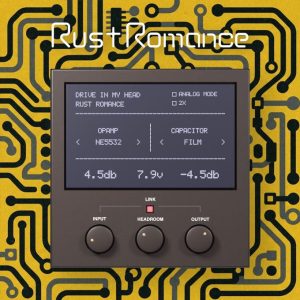
Free saturation VST for producers who want analogue character without obvious distortion. Fifteen op-amp models, five coupling caps.
The op-amp is the character. The capacitor is the room.
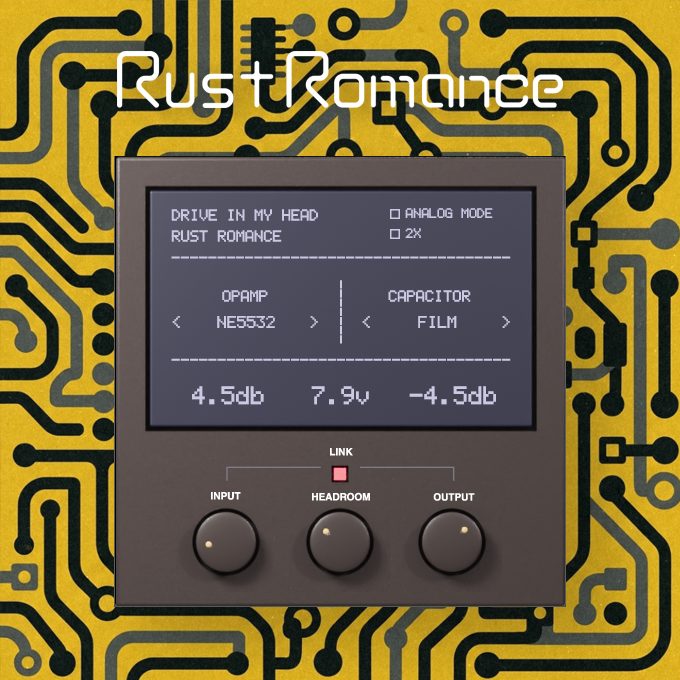
Drive in my head is a physically modelled op-amp line-driver plug-in. It is not a distortion box. It is fifteen op-amps and five coupling capacitors, wired into a WDF (Wave Digital Filter) circuit that behaves the way analogue silicon actually behaves — quietly, with weight.
What It Actually Does
“Drive” in the name is misleading on purpose. Drive in my head is not chasing overdrive or fuzz. It is chasing the sound of a signal that has passed through a real analogue amplification stage — the subtle compression of a real feedback loop, the tilt of a real coupling capacitor, the small drift of a real power rail.
Use it on sources that feel too clean, too digital, too “printed.” Instruments that will not sit in the mix, sample-based drums that feel weightless, virtual synths that read as computer sound. Drive in my head puts them behind a piece of analogue circuitry and lets the circuit do the rest.
Think of it less like a saturation plug-in and more like moving a DI signal onto tape, then back off — the numbers are the same, the feel is not.
Fifteen Op-Amps, Fifteen Characters
Each op-amp is modelled from its data-sheet gain-bandwidth, slew rate, output swing, open-loop gain, and topology (BJT input, JFET input, DiFET, Class-A discrete, Class-B output, Power BJT, OTA). The character comes out of the physics, not out of a curve.
The line-up spans hi-fi to intentionally ugly:
- Studio standards — NE5532, TL072, NJM4558DD, NJM4560DD, NJM4580DD, SE5532, OPA2604
- Reference-grade — OPA627 (DiFET), API 2520 (Neve / API discrete)
- Discrete Class-A — BA283 (Neve 1073 lineage)
- Cheap-and-charming — LM358 (Class-B crossover), LM741 (classic general-purpose), TDA2030 (a power-amp chip used as a line buffer, the way 80s / 90s budget gear did it)
- OTAs used out of their comfort zone — CA3080 and LM13700, the way early analogue delays and cheap synths abused them
Sweep the op-amp knob and the same signal takes on a different weight, thickness, and top-end without you touching a single tone control.
Five Coupling Capacitors
After the op-amp, the signal passes through a coupling capacitor before it leaves the plug-in. That cap is where a lot of the “vintage” feeling actually lives — it is what you hear when you say “this record sounds old.”
- None — direct-coupled, no capacitor colour
- Film — clean, transparent, low ESR
- Oil — vintage, faintly rolled highs
- Electrolytic — a clear softening of the top end
- Aged aluminium electrolytic — reduced capacitance and a much higher equivalent series resistance, the way an old cap on a cheap 80s / 90s device actually measures
That last one is the shortest path to the sound of a piece of consumer electronics that has been sitting in a cupboard for thirty years.
Analog Mode
Analog Mode adds the small imperfections that separate a real amplifier from a mathematically perfect one.
Under the hood, it injects a slow residual ripple into the simulated power rail — the kind of leftover mains-related motion that a real linear regulator never fully removes — and a very slow drift into the input offset voltage. Because gain, saturation, and asymmetry all reference that rail, the entire character of the plug-in gently breathes.
The effect is small on purpose. It is not modulation. It is the opposite of a “perfect” plug-in.
2X
2X sends the signal through a second identical copy of the selected op-amp / capacitor stage, in series. Every parameter stays linked between the two stages.
It is not a distortion booster. It is a doubled dose of the same colouration — useful when you want the character to survive being buried in a busy mix, or when you want the same op-amp voice twice in the signal path the way an old console would stack line amps.
Under the Hood
Drive in my head is built on Wave Digital Filter theory, using the chowdsp_wdf library and a custom non-linear feedback ODE solver (backward-Euler with in-loop Newton correction). Op-amp saturation is dispatched by topology — BJT and JFET use soft-clip forms, LM358 uses an Ebers-Moll softplus pair for its Class-B crossover, and CA3080 is modelled as an OTA macromodel following Bogason and Werner (DAFx-17), with the tanh non-linearity the paper listed as future work already implemented.
That is a long way of saying: closed-loop gain, bandwidth, saturation recovery, and rail clipping all emerge from the circuit, not from a hand-tuned curve.
Who It Is For
Drive in my head may be a good fit if you:
- Produce with virtual instruments and want them to sit in the mix without heavy processing
- Mix in-the-box and miss the feel of hardware line stages
- Design sound in a lo-fi, vintage, or “old consumer electronics” direction
- Enjoy plug-ins that model actual circuits rather than curves
- Want a subtle character tool, not an obvious distortion
Download
Drive in my head is now available on Rust Romance.
Sound is texture. Silicon is character.
Free Saturation VST - Drive in my head is live. Fifteen op-amp models, five coupling capacitor types, and an Analog Mode that lets the whole circuit breathe -- built for character, not obvious distortion.
Yes. Drive in my head is a free download. You need a one-time license key, sent to your email, to activate it on first launch -- there is no payment involved.
It runs your signal through a physically modeled analogue line-driver circuit, the kind of stage a signal passes through inside real analogue gear. The result is a subtle thickening and shaping of tone, not an obvious distortion effect.
Fifteen: NE5532, NJM4558DD, NJM4560DD, NJM4580DD, TL072, OPA2604, OPA627, API2520, SE5532, BA283, LM358, LM741, TDA2030, CA3080, and LM13700. Each one is modeled on its own real-world electrical behaviour -- covering BJT, JFET, DiFET, discrete Class-A, Class-B, Power BJT, and OTA designs -- so switching between them changes the tone.
Drive in my head includes five capacitor types -- None, Film, Oil, Electrolytic, and Aged Electrolytic -- placed at the plugin output. Each one colours the top end differently, from fully transparent (None, Film) to progressively rolled off and vintage-sounding (Oil, Electrolytic, Aged).
Analog Mode adds the small, natural imperfections of real analogue circuitry -- a slow drift in the power supply and a slight wander in the input level -- so the tone shifts gently over time instead of sounding perfectly static.
2X sends the signal through a second identical copy of the selected op-amp and capacitor stage, back to back. It doubles the amount of colouration rather than adding distortion or extra gain on top.
Drive in my head is available as a VST3 plugin and as a standalone application, for Windows and macOS.
Yes. Even as a free plugin, Drive in my head requires a one-time activation with a license key sent to your email address after you get it. This is separate from any payment -- it is simply how the free license is issued.