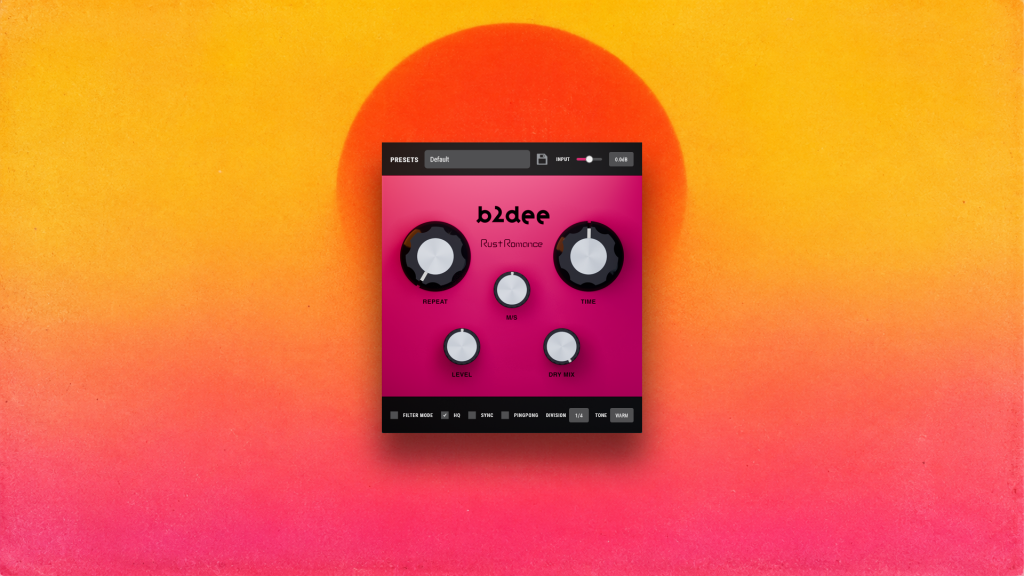
B2DEE: BBD Analog Delay Plugin Inspired by BOSS DM-2
B2DEE is a BBD analog delay plugin inspired by the legendary BOSS DM-2, combining the warm, dark sound of vintage bucket-brigade delay pedals with the creative flexibility of modern music production.
Developed by Rust Romance, B2DEE recreates the character of the classic DM-2 signal path through detailed circuit-level modeling, including the MN3205 BBD chip, NE570 compander, analog filters, and transistor stages.
But B2DEE is more than a vintage delay emulation.
With delay times ranging from 1 ms to 1600 ms, stereo Ping Pong processing, Mid/Side control, and a unique BBD Filter Mode, it brings the sound of a classic analog delay into modern DAW workflows.
Key features:
- BOSS DM-2-inspired analog delay circuit modeling
- MN3205 BBD modeling with 4096 stages
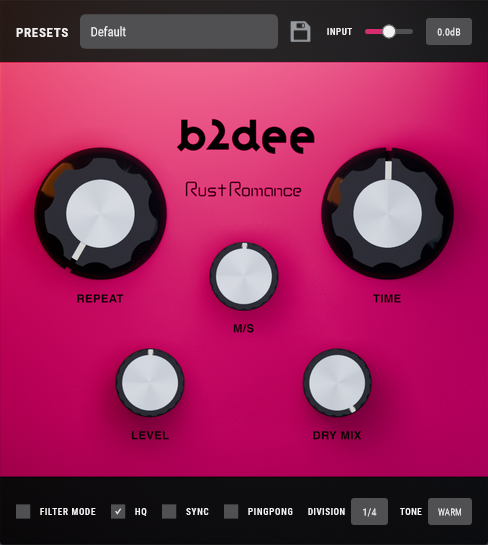
- Four selectable tone settings: DARK, WARM, CLEAR, and BRIGHT
- Extended feedback range with controllable self-oscillation
- Stereo delay with Ping Pong and Mid/Side processing
- BBD Filter Mode for vintage and lo-fi sound design
- Delay times from 1 ms to 1600 ms with DAW tempo sync
- HQ and NORMAL processing modes
- Zero plugin latency and 18 factory presets
What Is a BBD Delay? The Sound Behind the BOSS DM-2
The distinctive sound of the BOSS DM-2 comes primarily from its Bucket Brigade Device, or BBD.
Unlike a conventional digital delay, which can reproduce a signal with high accuracy, an analog BBD delay introduces subtle changes as the signal travels through its circuit.
High frequencies are gradually softened, noise and other analog characteristics become part of the sound, and repeated echoes develop a warm, dark texture.
The result is a smooth, musical delay that blends naturally behind the original signal.
This is one reason vintage BBD delays remain popular among guitarists, music producers, and sound designers.
Their character is often compared to tape echo, although the two technologies create their coloration through different processes.
The original BOSS DM-2 is a particularly memorable example of this sound. Its dark repeats, compact tonal character, and organic feedback behavior made it an important reference during the development of B2DEE.
A DM-2-Inspired Analog Delay with Modern Feedback Control
Although B2DEE draws heavily from the original BOSS DM-2, it is not intended to be an exact recreation of the hardware.
One characteristic of the original DM-2 that I found somewhat limiting was how quickly its feedback could enter self-oscillation.
That behavior is certainly part of the pedal’s personality. However, in modern DAW-based productions, I often wanted longer delay trails without the feedback becoming unstable.
B2DEE was designed to offer greater control over this behavior.
Self-oscillation begins when the feedback level exceeds approximately 85%.
Below that threshold, the plugin can produce exceptionally long, controlled delay trails while retaining the tonal character of its modeled BBD circuit.
This makes B2DEE useful not only for traditional guitar echoes but also for ambient textures, rhythmic delays, Dub production, and experimental sound design.
The goal was to preserve the personality of vintage hardware while expanding its practical possibilities.
Four Analog Delay Tone Settings: DARK, WARM, CLEAR, and BRIGHT
B2DEE provides four TONE settings that change the character of its modeled analog circuit.
Each setting influences the frequency response of the delayed signal, and those tonal differences accumulate as the feedback repeats.
- DARK: The closest tonal character to the original BOSS DM-2, with rounded highs and warm, subdued repeats.
- WARM: A slightly more open variation that retains the smooth character of an analog BBD delay.
- CLEAR: A more open response that allows greater high-frequency detail to remain in the echoes.
- BRIGHT: An extended tonal option that moves beyond the original DM-2 circuit, providing brighter repeats for contemporary production.
DARK and WARM are particularly suitable when searching for a classic vintage analog delay sound.
CLEAR and BRIGHT, on the other hand, open up possibilities that extend beyond the traditional role of a guitar delay pedal.
For example, brighter repeats can work well in rhythmically complex productions where a dark delay might become difficult to distinguish from the surrounding instruments.
Stereo Ping Pong Delay and Mid/Side Processing
Although the original BOSS DM-2 was a mono guitar pedal, B2DEE was designed for modern stereo music production.
The plugin processes the left and right channels through separate modeled circuits.
It also includes a Ping Pong delay mode that alternates repeats between the left and right channels.
In Ping Pong mode, the input is summed to mono and initially sent to the left channel. Each subsequent repeat moves to the opposite side, creating a rhythmic stereo effect.
Mid/Side Control for Stereo Imaging
Stereo imaging plays an important role in contemporary mixing.
For this reason, B2DEE includes a dedicated M/S (Mid/Side) balance control.
With a stereo source, this parameter allows you to shape the balance between the Mid and Side components of the processed signal.
Moving the balance toward SIDE can emphasize stereo width and create a more spacious delay image.
Moving it toward MID produces a narrower, more centered sound that can work particularly well for vintage and lo-fi production.
Consider a drum slapback delay running on an AUX channel.
In a conventional mixing setup, you might insert a separate stereo imaging plugin after the delay to adjust its width.
B2DEE allows this type of spatial adjustment directly within the delay plugin.
Creative Mid/Side Automation for Dub Delay
The M/S control becomes even more interesting when used with automation.
In Dub, ambient music, and experimental electronic production, long feedback trails can become an important part of the musical arrangement.
Automating the M/S balance allows these evolving echoes to shift between centered and wider stereo presentations.
A delay trail can gradually expand into the Side information or contract toward the center as it decays.
Combined with Ping Pong processing and extended feedback, this makes B2DEE a creative tool for building moving, evolving soundscapes.
BBD Filter Mode: Vintage Lo-Fi Sound Without Delay
One of B2DEE’s most distinctive features is Filter Mode.
Unlike conventional delay processing, Filter Mode allows the original signal to pass through the modeled BBD signal path without producing audible delay repeats.
The purpose is to capture the tonal coloration of the analog circuit itself.
You might think of this feature as a BBD Filter.
Instead of using the plugin to generate echoes, you can use it to change the sound texture of an instrument, drum, or sampled recording.
The signal passes through the modeled compressor, analog filters, BBD processing, expander, and de-emphasis stages.
DRY MIX sets the level of this colored signal, while LEVEL and REPEAT still control the echoes. Turn LEVEL all the way down for the pure BBD Filter sound.
This gives the sound a rounded, softened character associated with vintage analog electronics.
Lo-Fi Synthesizer Processing
Modern software synthesizers can produce extremely clean, detailed sounds.
While that clarity is often desirable, it can also make a synthesizer feel too polished for certain musical styles.
B2DEE’s Filter Mode can soften these textures and create a more nostalgic character.
A bright digital synthesizer can take on a warm, rounded quality reminiscent of inexpensive vintage recording equipment.
The result can evoke the character of old recordings without requiring a separate tape emulation or conventional lo-fi effect.
Lo-Fi Hip-Hop Drum Processing
Filter Mode can also be particularly effective on drums.
Apply it to a snare drum, for example, and the softened high frequencies and analog coloration can help create a dusty, mellow character.
This makes it useful for Lo-Fi Hip-Hop, Boom Bap, experimental Hip-Hop, and sample-based production.
Of course, there are already countless tools for this kind of sound, from the Roland SP-404 to modern lo-fi processing plugins.
But the familiar lo-fi aesthetic has become increasingly standardized.
Simply applying a conventional low-pass filter, bitcrusher, or vinyl-noise effect does not necessarily create a distinctive sonic identity.
I believe finding unusual combinations of sound-processing tools is becoming increasingly important for producers who want to develop their own signature textures.
B2DEE’s Filter Mode offers another way to approach that process.
Try using it quietly on a snare, synthesizer, or sampled instrument.
You might discover a texture that feels different from your usual lo-fi processing chain.
Inside the B2DEE Analog Circuit Model
B2DEE’s analog delay engine is based on the signal path and component values of the BOSS DM-2 V2 circuit.
The modeled signal travels through the following stages:
Input Buffer & Pre-Emphasis → NE570 Compressor → Input Filter → MN3205 BBD → Output Filter → NE570 Expander → De-Emphasis
Feedback returns to the compressor’s summing node, following the arrangement of the original circuit.
Consequently, each repeat travels through the complete signal path again.
This is an important distinction from a conventional digital delay with a filter applied to its feedback.
In B2DEE, the character of the repeats comes from repeatedly processing the signal through the modeled analog components.
MN3205 BBD Modeling and Clock Behavior
At the center of the delay circuit is the MN3205 Bucket Brigade Device.
A BBD transfers an audio signal through a chain of small capacitors, with each transfer controlled by an internal clock.
B2DEE models the MN3205’s 4096 stages and processes the BBD signal according to its own clock rate rather than simply using the host DAW’s sample rate.
Depending on the delay time, the modeled clock operates between approximately 6.83 kHz and 102.4 kHz.
Slower clock rates contribute to the characteristic sound of longer BBD delays. These include:
- Gradual high-frequency loss
- Aliasing and clock-related artifacts
- Signal degradation during transfers
- Noise associated with the BBD stages
The plugin also models noise generation throughout the bucket chain.
These characteristics are produced as part of the delay-line processing rather than added as a separate effect over a clean digital delay.
NE570 Compander Modeling
The original DM-2 uses an NE570 compander to manage noise in the BBD signal path.
The incoming signal is compressed at a 2:1 ratio before entering the BBD and expanded at a 1:2 ratio afterward.
While the primary purpose is noise reduction, the compander also influences the dynamic character of the delayed signal.
Its response subtly shapes the envelope of the repeats, helping them blend smoothly behind the original sound.
B2DEE models the compressor and expander stages, including their rectifiers and associated circuit networks.
Analog Filters and Transistor Nonlinearity
The analog filters surrounding the BBD are another important part of the DM-2 sound.
B2DEE models the filter networks together with the nonlinear behavior of their transistor buffers.
These stages are processed sample by sample rather than treated as perfectly linear components.
The TONE settings also interact with these modeled circuit elements.
DARK, WARM, and CLEAR adjust the effective MN3205 output resistance, which changes the response of the following filter.
BRIGHT extends the design by modifying the modeled filter capacitor values to provide a more open high-frequency response.
Because these components are part of the feedback path, their tonal contribution develops with each repeat.
Every echo is another journey through the circuit, not merely another copy of the previous signal.
Delay Time: From 1 ms to 1600 ms
The original BOSS DM-2 provides a delay range of approximately 20–300 ms.
B2DEE extends this range considerably, offering delay times from 1 ms to 1600 ms.
Within the original 20–300 ms range, the BBD clock controls the delay time in a manner inspired by the hardware.
Below 20 ms, the modeled clock remains at its maximum rate.
Above 300 ms, the clock remains at its minimum rate while the delay is extended, preserving the darker character associated with slower BBD processing.
This expanded range makes the plugin useful for everything from very short spatial effects to extended ambient delay trails.
DAW Tempo Sync
B2DEE also supports tempo synchronization.
When SYNC is enabled, the delay time follows the host DAW’s tempo.
Available divisions range from two bars to 1/64 notes, including dotted and triplet values.
This allows the plugin to work naturally in rhythm-focused electronic music, Hip-Hop, and other tempo-based productions.
INPUT Control: Drive the Modeled Analog Circuit
B2DEE includes an INPUT control with a range of ±10 dB.
Increasing the input level drives the modeled transistor stages, compander, and BBD circuit harder.
Reducing the level produces a cleaner response.
The delay output is compensated by the corresponding amount, allowing you to explore different circuit characteristics without simply increasing the overall output level.
This provides another way to shape the tone beyond the four TONE settings.
HQ and NORMAL Processing Modes
B2DEE offers two processing modes.
HQ is the default mode and uses the full circuit model, including more detailed transistor behavior, the NE570 compressor network, coupling capacitors, and nonlinear calculations.
NORMAL uses a lighter version of the processing engine to reduce CPU usage.
The two modes are not intended to sound completely identical.
NORMAL can be treated as an alternative tonal character rather than merely a lower-quality preview mode.
Choose whichever works best for your music.
Designed for Modern DAW Production
B2DEE also includes several features intended to improve everyday production workflows.
- Zero plugin latency: No additional plugin delay compensation is required.
- Accurate delay-tail reporting: Tail duration is calculated from the TIME and REPEAT settings to help prevent echoes from being cut off during offline rendering.
- 18 factory presets: Presets include drum slapback effects, tempo-synchronized rhythmic delays, and BBD Filter settings.
These features allow B2DEE to function as a practical mixing tool as well as an experimental sound-design processor.
Creative Ways to Use B2DEE
Although the plugin began as an exploration of the BOSS DM-2 sound, its applications extend far beyond vintage guitar delay.
Vintage Guitar Delay
Use DARK or WARM for smooth, rounded repeats inspired by classic BBD pedals.
Drum Slapback Delay
Create short delays on an AUX channel and use the M/S balance to shape their position in the stereo field.
Dub Echo and Feedback Effects
Combine long feedback settings, Ping Pong mode, and M/S automation to create moving delay trails.
Ambient and Electronic Music
Use extended delay times and stereo processing to build atmospheric textures and evolving echoes.
Lo-Fi Hip-Hop and Sample Processing
Use Filter Mode to soften samples, reshape synthesizer tones, or add vintage character to drum sounds without relying on conventional delay repeats.
B2DEE Plugin Specifications
| Feature | Specification |
|---|---|
| Plugin format | VST3 |
| Platform | Windows, 64-bit |
| Audio channels | Mono / Stereo |
| Delay time | 1–1600 ms |
| Tempo synchronization | 2 bars to 1/64 triplet |
| BBD model | MN3205, 4096 stages |
| Tone settings | DARK / WARM / CLEAR / BRIGHT |
| Stereo processing | Stereo / Ping Pong / Mid-Side |
| Additional processing | BBD Filter Mode |
| Quality modes | HQ / NORMAL |
| Plugin latency | 0 samples |
| Factory presets | 18 |
Frequently Asked Questions About B2DEE
Is B2DEE an exact emulation of the BOSS DM-2?
No. B2DEE is inspired by the BOSS DM-2 and models important elements of its analog signal path, including the MN3205 BBD, NE570 compander, and associated filters. However, it also includes expanded feedback control, longer delay times, stereo processing, and additional features not found on the original pedal.
What is the difference between a BBD delay and a digital delay?
A BBD delay transfers an analog signal through a chain of capacitors controlled by a clock. This process, together with the surrounding analog circuitry, creates characteristic tonal changes, noise, and artifacts. A conventional digital delay can reproduce its input more transparently, although digital processing can also be designed to emulate analog characteristics.
Can B2DEE create self-oscillating feedback?
Yes. B2DEE is designed to enter self-oscillation at feedback settings above approximately 85%. Lower settings allow long, controlled delay trails without quickly becoming unstable.
What does B2DEE Filter Mode do?
Filter Mode processes the original signal through the modeled BBD signal path without producing audible delay repeats. It can be used to give synthesizers, drums, and samples a warmer, darker, more vintage character.
Does B2DEE support stereo and Ping Pong delay?
Yes. B2DEE supports mono and stereo operation, Ping Pong delay, and Mid/Side balance control. These features allow producers to shape the stereo presentation of the delayed signal.
Is B2DEE suitable for Lo-Fi Hip-Hop and Dub music?
Yes. Filter Mode can produce softened, vintage-style textures for Hip-Hop and sample-based music, while the extended feedback, Ping Pong, and M/S controls provide creative possibilities for Dub and experimental delay effects.
Vintage Analog Character, Modern Creative Freedom
The philosophy behind B2DEE has remained consistent throughout its development:
Capture the distinctive sonic character of the BOSS DM-2 while making the plugin more flexible, expressive, and practical for modern music production.
Whether you are looking for a warm analog guitar delay, an experimental Dub echo, a stereo delay for electronic music, or an unusual BBD coloration tool for Lo-Fi Hip-Hop, B2DEE offers several different ways to explore the sound of classic analog circuitry.
And sometimes, the most interesting results come from using an effect in a way it was never originally intended.
Explore more Rust Romance audio plugins
BOSS and DM-2 are trademarks of their respective owners. B2DEE is an independent Rust Romance product and is not affiliated with or endorsed by BOSS or Roland.